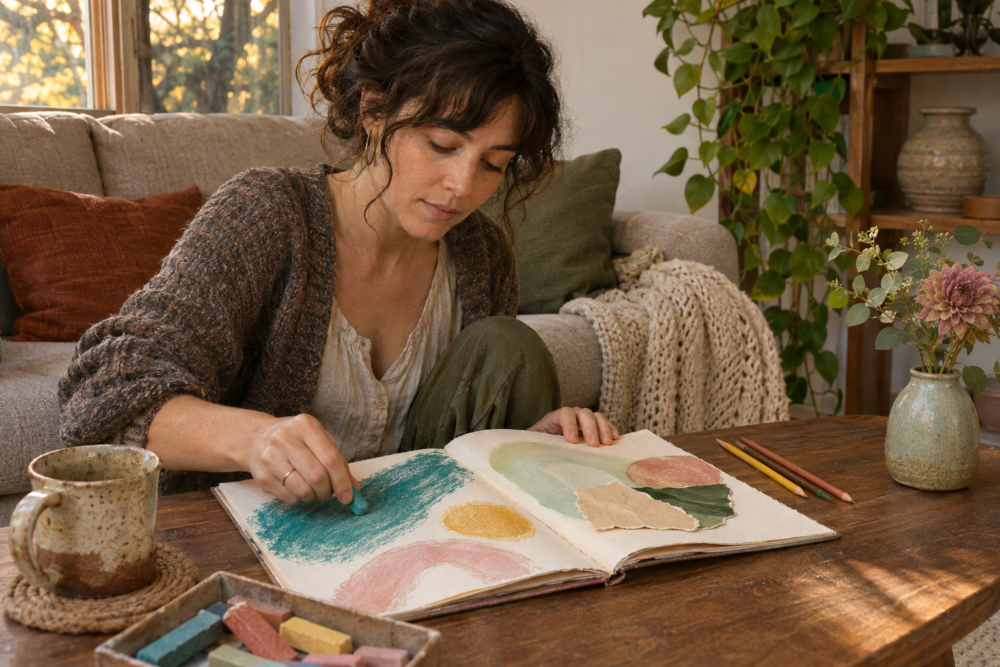
Art journaling for mental health uses images, colors, marks, collage, and optional words to help you express feelings when stress makes them hard to describe. A page in a comforting color or a meaningful image can be enough to begin.
The practice may help you notice emotions and find a moment of relief, but it does not promise a particular result or replace mental health care. Simple exercises can make it easier to start. Use whatever materials you have, and keep the practice flexible. Related: How to Start Journaling for Mental Health.
What art journaling for mental health can offer—and how it differs from therapy
An art journal lets you explore feelings through images, colors, marks, collage, and optional words. For example, if you feel overwhelmed, you might use dark, crowded marks to express that feeling without writing a full account. Related: Gratitude Journaling for Mental Health: A Balanced Guide to Benefits and Limits.
Putting a feeling on paper may make it easier to notice and reflect on. The sample was too small to establish that the changes were statistically significant. The finding does not show that journaling reliably reduces anxiety or stress.
Art journaling is creative self-care you direct yourself; art therapy is a professional mental-health service. The American Art Therapy Association describes art therapy as work within a psychotherapeutic relationship with an appropriately trained and credentialed professional.
- Art journaling: You choose what to make and whether to add words. It may help you express and recognize emotions, but effects vary.
- Art therapy: A qualified professional uses art within a therapeutic relationship to support mental health.
For a broader introduction to writing-based approaches and choosing a format, see this practical overview of mental health journaling.
Start with paper and materials you already have
You do not need drawing skills or special supplies to start an art journal. Choose paper and one tool, then make a page using a word, image, or color to express an emotion.
- Choose paper. Use a notebook, loose paper, a three-ring binder, or an old book. Matte pages that lie flat are easier to work on than glossy pages.
- Limit your art journal supplies. Start with a pencil, crayon, or marker. To try collage, paste photographs, labels, or wrappers onto your page.
- Make and date a page. For example, choose a comforting color, add a few pencil marks, and write the date without judging the result.
Ordinary notebook paper works well for dry marks and pasted scraps. For heavier wet work, choose paper made for the medium: Strathmore’s paper guidance distinguishes about 190 gsm paper for sketching and practice from 300 gsm paper for heavier watercolor washes. Mixed media paper typically has a smoother surface for drawing.
Easy art journaling prompts for mental health when words are difficult
When words are hard to find, try a simple drawing or color prompt: make marks, fill spaces, or show a feeling without naming it. Choose the least emotionally demanding activity; for prompts based on written reflection, see focused mental health journaling prompts for recognizing mood.
Draw a continuous winding line and color the spaces
This beginner exercise gives you something to do without choosing an emotional subject. Use a pencil and any coloring tool you have.
- Move your pencil in one continuous winding line without lifting it from the page.
- Look for the spaces enclosed by the line.
- Color those spaces in any order, using colors you like.
- Stop when you feel finished; the page needs no recognizable subject or explanation.
For example, a line might loop across the page and create several uneven spaces to fill. Treat it as mindful drawing—a way to focus on making marks—not as a way to achieve a particular mental health outcome. VCU describes the activity in its art journaling suggestions.
Make a page in a color you find comforting
Choose a color that feels comforting to you, then use it across the page. The Younique Foundation suggests this as a general art-journaling activity, not as a tested treatment for low mood or anxiety.
- Pick one color that feels right to you today.
- Make any marks you can: broad strokes, small shapes, dots, or repeated lines.
- Fill as much or as little of the page as you want.
- Finish when you choose; you do not need a complete picture or written explanation.
Color meanings are personal. You do not need to choose a particular color because someone says it should feel calming. A page of blue loops, for instance, can simply be a page of blue loops.
Show an emotion without naming it
Show how you feel now without writing the emotion’s name.
- Choose colors, lines, shapes, or images that seem to fit how you feel now.
- Put them on the page in any arrangement, without trying to draw something recognizable.
- Pause when you are ready, then notice the page without judging its artistic quality.
- Add one closing word only if language feels easier after making the image.
You decide what the marks mean. There is no symbol key to decode and no diagnosis to draw from the page. The activity is simply one option for expressing and working through feelings.
Use a collage journal for self-expression without drawing
You can express a feeling or hope in a collage journal without drawing: choose images and words, arrange them, then attach them to paper.
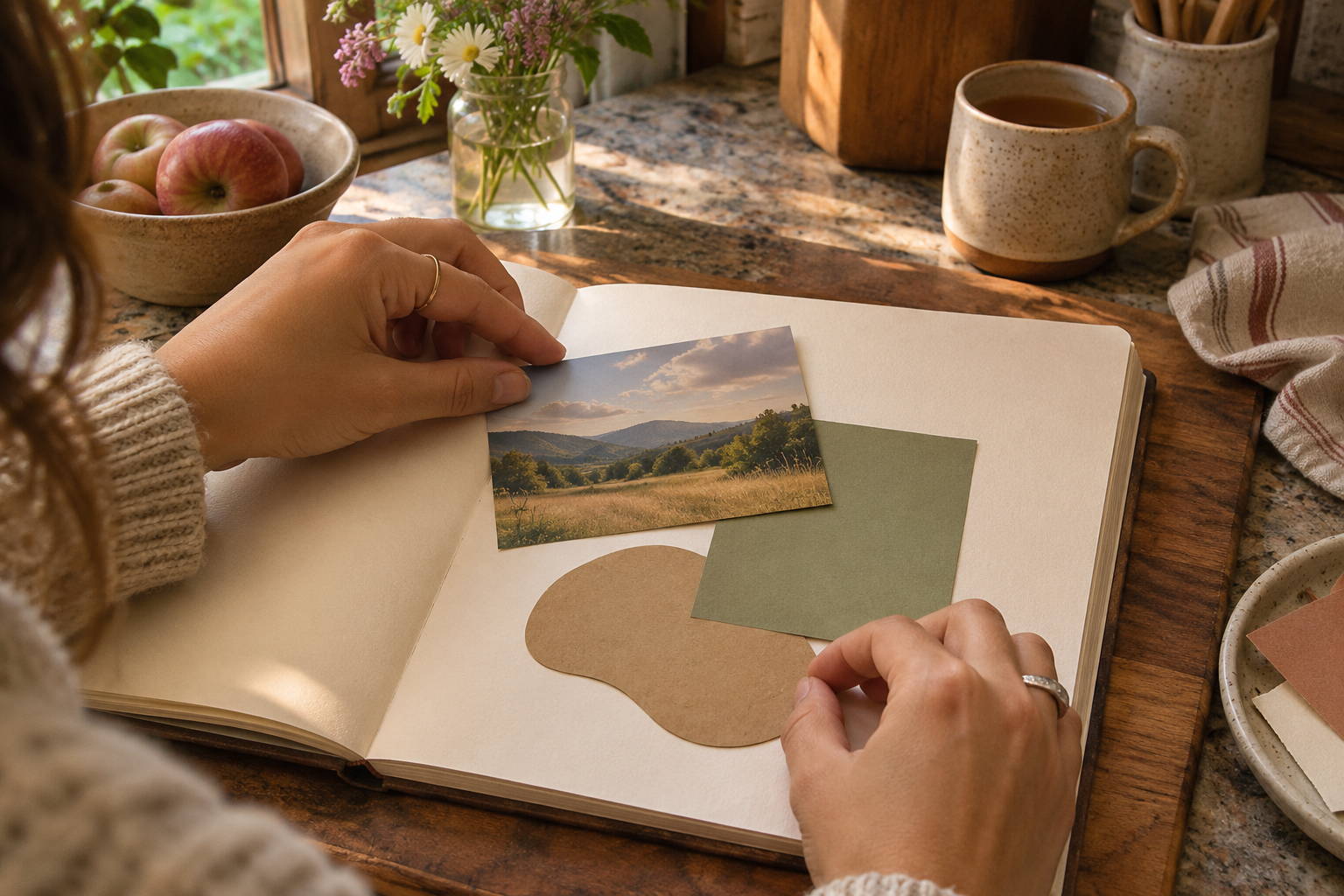
- Choose a theme, such as a quotation that matters to you or something you want more of in life.
- Gather photographs, labels, wrappers, or words that connect with the theme.
- Arrange the pieces on the page before attaching them, moving them around until the layout feels right.
- Attach the pieces with glue or tape, then add optional handwriting, color, or marks.
The pieces do not need to tell a complete story; their connections may be meaningful only to you.
Build a page around a meaningful quotation
Choose a quotation that matters to you; it does not need to sound cheerful or inspirational. Write or cut out the words, place them on the page, and surround them with images or scraps that connect with their meaning. For example, a line about belonging might sit beside a familiar photograph, a food label from a shared meal, or a color that reminds you of home.
Arrange the pieces before attaching them so you can easily change the layout. Add handwriting if you want to note what the quotation brings to mind, or let the images speak for themselves.
Picture something you want more of in your life
Choose one thing you would like more of, such as rest, connection, or time outdoors. Gather images, colors, and optional words that suggest it, then arrange them on a page. A wish for more rest might take shape through a soft-colored wrapper, a photograph of a quiet place, and the handwritten word “pause.”
The page can express a hope without becoming an action plan. You do not have to explain the images or resolve any mixed feelings they bring up. Making the page can simply be a form of self-care.
Keep the practice flexible rather than chasing a streak
There is no set schedule for an art journal. Return when it feels manageable, for as long or as briefly as suits you. A 2025 digital art-making feasibility study found no significant link between how often participants took part and anxiety reduction; participation also declined after week four. It did not establish a journaling routine or show that more frequent practice works better.
Try this low-pressure approach:
- Choose a familiar prompt. Reuse a comforting color or a simple line-and-color activity instead of inventing a new project each time.
- Limit your supplies. Pick a few materials to make getting started easier.
- Set a small task. For example, add one color or a few shapes, then stop without polishing or filling the page.
- Date the page. This helps you look back on your creative self-care without having to make an entry every day.
Letting go of perfectionism can make the practice easier to return to. Use it as personal experimentation, not a treatment schedule; the VA’s 15–20 minutes daily for four days applies to an expressive-writing exercise, not art journaling. If you want broader beginner routine advice, see Journaling for Mental Health: A Practical Guide to Writing for Your Well-Being.
If journaling makes you feel worse, pause instead of pushing through
If an art-journaling page makes your feelings hard to manage, stop and set it aside rather than finishing the prompt. Creative self-care should not pressure you to keep working through feelings as your distress rises.
- Close or move the page. The U.S. Department of Veterans Affairs’ therapeutic-journaling guidance advises stopping when feelings become unmanageable. It also cautions against repeatedly returning to the same subject without progress.
- Ground yourself, if that feels comfortable. Sit comfortably and breathe slowly. Then name five things you can see, five sounds you can hear, and five things you can feel, choosing things that do not distress you. This is general psychological-first-aid guidance, not a validated art-journaling method.
- Choose whether to return. If you feel settled and want to try again, use a less intense starting point, such as filling a page with a comforting color. You can also leave the journal closed.
Grounding may not suit everyone; stop if it adds to your distress. If negative feelings linger or journaling repeatedly makes you feel worse, speak with a qualified mental health professional, such as a psychologist, counselor, or physician. Anxiety, depression, or other mental health concerns deserve appropriate support.
Conclusion
An art journal can give you a simple way to express feelings without explaining them in words or making polished art. After a session, consider whether the activity felt manageable and whether you would choose the same prompt again.
Use that observation to guide your next session: repeat a prompt that suited you, simplify one that felt demanding, or choose a different activity. Adjust the practice based on how it felt, rather than how the finished page looks.
The facts and figures here were checked against the sources linked in this article on November 7, 2026.