
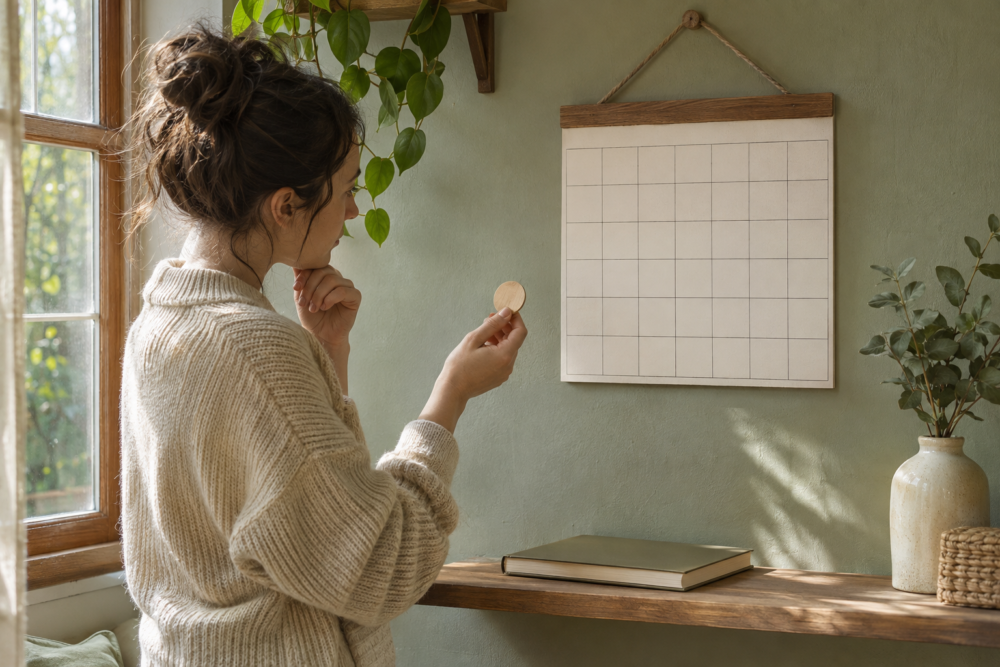
Start with the daily calendar, write for a few minutes, and use weekly check-ins to notice which exercises help you understand yourself and stress more clearly.
Brief entries, skipped days, and rest days all fit the plan; you don’t need to catch up. Journaling may support stress management and help you become more aware of concerns. The aim is self-awareness—not a promise that symptoms will improve. You can also explore the free printable options or read what to do if writing feels upsetting.
Set up your 30-day mental health journaling challenge
Choose a place to write, set a brief time limit, and use one prompt at a time. A notebook and a smartphone both work, and you can write or draw. You do not need to polish your spelling or fill a page.

- Choose your format. Pick paper or a phone, and decide where to keep your entries so you feel comfortable with their privacy. Sharing is optional.
- Set a boundary. Try the optional 10-minute timer used in Journal Party’s challenge, and stop when it ends. Write less if that suits you.
- Keep the aim modest. Use prompts to notice thoughts, feelings, concerns, and patterns related to stress or anxiety.
For more journaling for beginners setup ideas, read the practical overview of mental health journaling.
Your daily calendar: 30 prompts for noticing what matters
Answer the day’s prompt, or mark it as rest or skipped and move on.
The prompts offer optional ways to explore situations, thoughts, feelings, what you appreciate, and practical next steps. Write a few words, draw, or leave a prompt for another day if it does not suit you.
| Day | Journaling prompt | Completion |
|---|---|---|
| Day 1 | What brought you here, and what would make this practice useful? | Complete / rest / skip: __________ |
| Day 3 | Which feeling stands out most, and what was happening when you noticed it? | Complete / rest / skip: __________ |
| Day 5 | What is taking up mental space, and what might need attention? | Complete / rest / skip: __________ |
| Day 6 | Describe something that felt manageable or comforting today. | Complete / rest / skip: __________ |
| Day 8 | Describe a situation and the thought that followed it. | Complete / rest / skip: __________ |
| Day 9 | What feeling came with that thought? | Complete / rest / skip: __________ |
| Day 10 | What supports your interpretation, and what points toward another explanation? | Complete / rest / skip: __________ |
| Day 11 | What would be a more balanced or neutral way to describe the situation? | Complete / rest / skip: __________ |
| Day 12 | Which current concern can you take practical action on, and which is outside your control? | Complete / rest / skip: __________ |
| Day 13 | For a concern you can act on, what could you do, how, and when? | Complete / rest / skip: __________ |
| Day 15 | What helped you handle a difficult moment recently? | Complete / rest / skip: __________ |
| Day 16 | What have you noticed about your energy during ordinary activities? | Complete / rest / skip: __________ |
| Day 17 | What small kindness did you notice or offer, and how did it feel? | Complete / rest / skip: __________ |
| Day 18 | Describe a moment when you felt present rather than distracted. | Complete / rest / skip: __________ |
| Day 19 | What concern could you discuss with someone you trust, if you choose? | Complete / rest / skip: __________ |
| Day 20 | Which manageable self-care practice would you like to make room for? | Complete / rest / skip: __________ |
| Day 22 | What did you learn by describing an event without judging yourself? | Complete / rest / skip: __________ |
| Day 23 | Which entry about something you appreciate would you like to revisit, and why? | Complete / rest / skip: __________ |
| Day 24 | What does a recent response to stress suggest about your needs? | Complete / rest / skip: __________ |
| Day 25 | What concern needs a practical next step rather than more writing? | Complete / rest / skip: __________ |
| Day 26 | What would you like to remember from an ordinary good-enough day? | Complete / rest / skip: __________ |
| Day 27 | Which prompt would you willingly repeat? | Complete / rest / skip: __________ |
| Day 29 | What would a manageable journaling routine look like after this challenge? | Complete / rest / skip: __________ |
For example, after noting that a friend did not reply, record your first thought and feeling. Then weigh what supports or challenges that interpretation. If no practical step is available, you can simply note that.
Use these exercises to reflect on how you respond to emotions and which healthy coping strategies you want to practice. For more mood-pattern prompts, explore additional options.
Missed a day? Use rest days and low-energy entries without catching up
If you miss a day, return to the next prompt you want to try; do not catch up or restart the calendar. A flexible journaling challenge can include pauses, skipped prompts, and entries completed after the calendar month ends.
- Missed a day: Pick up with the next prompt that interests you, or pause the sequence and return later. Journal Party’s challenge also advises continuing rather than restarting; its instructions are a format, not a clinical rule.
- Low energy: Write a sentence, make a short list, doodle, or take a rest day on purpose. For example: “Right now I notice ___, and what I need is ___.” Rochester’s journaling guidance permits brief or nonverbal entries, so choose what feels manageable.
- Nothing to write: Repeat a prompt that helped before, or describe what is happening right now. Journal Party suggests reusing useful prompts when a new one draws a blank.
Consistency means returning to what helps you, not protecting a streak. Keeping your practice flexible can give you room to reflect without making each entry a test of how well you cope.
Use weekly reflections to decide what is actually helping
A weekly journaling reflection can help you turn daily check-ins into practical choices. Notice what repeats, keep exercises that feel useful, and adjust what feels burdensome. The aim is self-awareness and mental clarity—not a particular mood score.
TEO Counselling’s reflection workbook suggests rating mood and energy on a 1–10 scale, reviewing after Days 7, 14, 21, and 28, then comparing the first entry with the closing one. Treat ratings as personal observations, not diagnostic scores or proof that journaling caused a change. Words such as “steady” or “drained” can work instead. A daily check-in template can give you a reusable place to record them.
At each weekly review, write a few notes:
- Notice: What situation, thought, or emotion appeared more than once?
- Keep: Which prompt or exercise felt useful enough to repeat?
- Adjust: What would make the next stretch feel more manageable?
For example, if appreciation entries felt easier to return to than open-ended worry entries, choose more appreciation prompts and shorter writing sessions. That can support stress management without turning the challenge into a test of personal growth.
At the end, compare your first and final entries. Note any patterns, what felt useful or burdensome, and what you want to continue. Choose a manageable routine—or stop the experiment if journaling did not suit you.
Free printable options for taking the challenge offline
Two publishers offer free printable options, with different access requirements. Each offers a separate 30-day journal challenge with its own daily prompts. Neither is a printable version of the calendar above.
| Resource | What it includes | Access |
|---|---|---|
| Journal Party’s 30-day journaling challenge PDF | Two pages with 30 prompts and a checkbox for each day; write entries in a separate journal. | Free download; no email or signup required. |
| Passion Planner’s 30 Day Journal Challenge | 30 prompts in a US-letter-sized PDF. | Listed at $0; enter an email address to receive the download link. |
Choose Journal Party if you prefer direct access without sharing an email; choose Passion Planner if email delivery suits you. To follow the exact prompt sequence offline, print the calendar above instead.
If writing makes you feel worse, pause rather than push through
If a prompt feels too intense, stop the entry. Set it aside, then choose a gentler subject or take a break. Finishing is optional.
- Pause if writing brings up distress you feel unable to cope with, or increases stress or hypervigilance. The VA’s therapeutic journaling guidance recommends stopping in that situation.
- Switch to a neutral detail. For example, describe an ordinary object nearby or a manageable moment from your day. You can also leave the page blank and return to a gentler prompt another time.
- Try a soothing activity, such as breathing, walking, or contacting someone you trust, if you need help settling after you stop.
- Contact a qualified health professional if self-care is not helping or your symptoms worsen. This self-reflection challenge is not treatment; clinician-delivered Written Exposure Therapy for PTSD is a separate psychotherapy, as described by the VA National Center for PTSD.
Urgent help in the United States: Call or text 988 for a suicidal crisis or emotional distress. Call 911 for a life-threatening emergency, following NIMH’s guidance.
Conclusion
This month-long journaling plan helps you discover which kinds of writing help you notice your experiences and needs. Completion means learning what feels useful—not producing perfect entries or keeping an uninterrupted streak.
For your next entry, choose one prompt and a simple sign of usefulness: naming a feeling, clarifying a concern, or identifying a practical next step. At your next weekly review, use that sign to decide whether to repeat the prompt, adapt it, or try another.
The facts and figures here were checked against the sources linked in this article on November 8, 2026.