

Journaling for mental health means putting your thoughts and feelings into words to help you reflect and support your emotional well-being. If you want relief or clarity but do not know what to write, even a sentence or a list can count.
Writing is a self-care tool that may help you notice emotions, stress, or anxiety. A practical approach can help you understand what journaling may offer, choose a way to write, find prompts, and recognize when writing is not helping.
What journaling for mental health can help you notice
Writing about thoughts and feelings can help you name emotions, spot recurring thoughts, and take a step back from them. This may help you understand yourself, reflect on your experiences, and think more clearly. Still, it does not guarantee emotional release or reduced stress. Related: How to Start Journaling for Mental Health: A Beginner’s Guide.
For example, after feeling anxious about a work message, you might write, “I’m worried they’re upset with me.” Seeing the thought on the page can make it easier to ask what supports it and what points to another explanation. The NHS thought record uses this kind of structured examination: it asks writers to note a situation, their thoughts and feelings, evidence for and against an unhelpful thought, and a more balanced alternative.
- Naming emotions: “I feel tense and disappointed” can be more specific than “I feel bad.”
- Noticing patterns: Entries may reveal that certain situations repeatedly bring up stress or anxiety.
- Creating distance: Writing a thought down can help you examine it rather than automatically treating it as fact.
A systematic review published in 2022 included 20 randomized trials, mostly expressive-writing interventions. The review reported an average 5% reduction in mental-health questionnaire scores compared with control groups, with substantial variation between trials. That figure reflects a change in questionnaire scores, not a recovery rate. It does not show that every writing approach works equally well.
Choose a writing approach that matches what you need
Choose a format based on your goal: examine a difficult thought, set worries aside, notice what you appreciate, or explore an emotional experience. There is no single best format for everyone.
| Your goal | Method | What to write | Timing for this exercise |
|---|---|---|---|
| Examine unhelpful or negative thoughts | The NHS thought record | Note the situation and feelings, the thought, evidence for and against it, a more balanced alternative, and how you feel afterward. For example, you might worry that a friend’s short reply means they are angry. Consider other explanations and what supports each one. | The NHS worksheet gives no set duration or schedule. |
| Separate practical worries from worries you cannot act on now | Scheduled worry writing, or “worry time” | Write down what is worrying you. Then separate problems you can take a practical step to address from worries you cannot resolve right now. | About 10–15 minutes for the NHS worry-time exercise. |
| Notice specific things you appreciate | Gratitude journaling | Record up to five things you appreciate, such as a helpful conversation or a quiet moment outdoors. Berkeley’s exercise asks you to describe specific experiences. | Berkeley recommends 15 minutes at least three times a week for at least two weeks. |
| Explore an important emotional experience | Expressive writing | Write about an important emotional experience. The VA exercise allows you to revisit one event or write about different events; choose an experience that does not feel too upsetting to handle now. | 15–20 minutes on each of four consecutive days in the VA exercise. |
These timings describe specific exercises, not a daily requirement for everyone. A thought record can help you examine a belief, while worry time gives you a set time to focus on worries. Writing may also help you understand yourself and manage your emotions, but you do not need to force a format that does not suit your needs.
Start simply—and choose where your entries will live
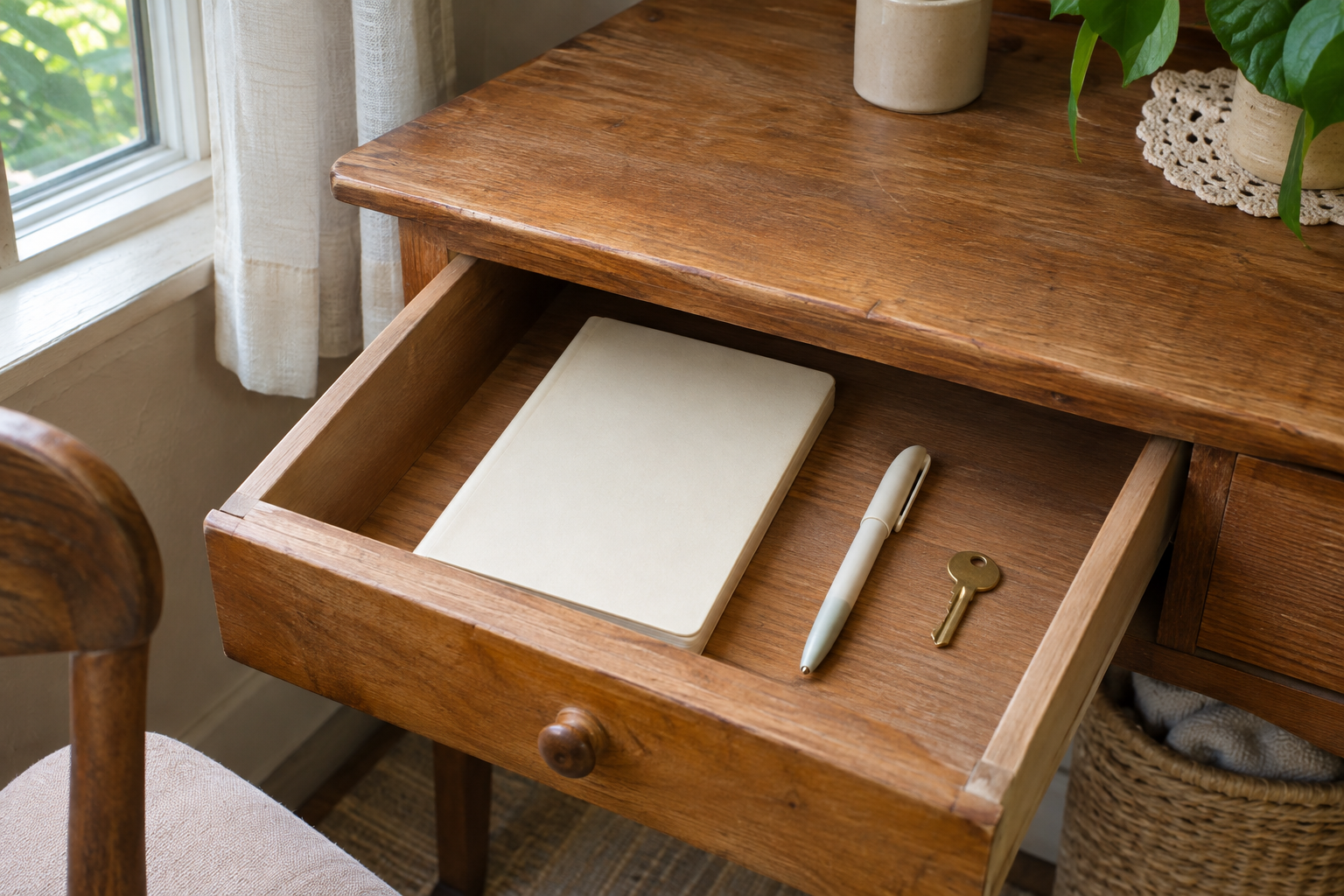
Choose a format you can use and a place others cannot casually access. A sentence, list, or drawing can be a complete entry. You do not need polished writing or a daily journaling habit.
Make the first entry small enough to begin
The University of Rochester Medical Center’s Behavioral Health Partners says an entry can be a sentence naming a feeling, a list of worries, a drawing, or even a scribble. You can write on paper, type, or dictate. Choose the format that feels easiest to return to, since no option suits everyone.
For example, write “I feel tense about tomorrow” or list the tasks on your mind. You do not need to write daily. Choose a manageable routine and treat a missed day as a pause, not a failure. This flexible personal practice differs from the specific timed writing procedures described above.
Check access, logins, and cloud settings
On a shared device, protect entries with practical steps drawn from NSW Health’s shared-device guidance. Before writing, avoid saving login details or selecting “Remember me.”
Lock the screen if you step away; afterward, log out and close the browser. Avoid downloading personal files, or delete them when finished.
Cloud privacy depends on the service and its settings, not simply on whether an app is called a journal. Apple says Journal entries in iCloud are end-to-end encrypted when two-factor authentication and a passcode are enabled; users control which suggestions they share with journaling apps, according to Apple’s privacy notice. Check the storage and sharing settings for your chosen service. For a paper journal, consider who can reach the place where you keep it. This is a precaution, not a guarantee of confidentiality.
Use a prompt when the page feels blank
If you do not know where to start, write about one situation. Describe how it made you feel and what you might do next. A few focused questions can help you notice your thoughts and feelings without forcing a particular conclusion.
- For anxious thoughts: What happened? How did you feel at first? What unhelpful thought came up? What supports that thought, and what points against it? Is there a more realistic or neutral way to see the situation? How do you feel after considering that alternative? The NHS thought-record exercise uses this sequence to examine a thought.
- For a worry: Is there an action you can take? If so, what is the first step, and when will you take it? If no action is possible now, acknowledge that and set the worry aside for the moment.
- For low mood or self-criticism: What would you say to a close friend in the same situation? Try writing that response to yourself. This can help you understand yourself and speak to yourself with kindness and balance; it does not have to sound cheerful. University of Delaware’s Reflective Healing guidance suggests this perspective for self-critical thoughts.
- For appreciation: What specific person, event, or everyday experience did you appreciate today? Naming one small detail can offer a different focus, including when you are coping with depression.
These journal prompts are optional starting points, not a test. Choose the question that fits your current stress or mood, and skip any that feel unhelpful.
When writing becomes a loop instead of a release
Writing can sometimes leave you feeling worse, especially if it keeps you circling the same self-critical story. Temporary sadness can happen after expressive writing, but it is not a necessary or desirable sign of progress.
The U.S. Department of Veterans Affairs says expressive writing may bring temporary sadness lasting minutes or hours, particularly during the first two days. The University of Delaware’s reflective-writing guidance warns that repeatedly rehearsing the same negative story can keep you caught in a familiar script rather than help you find another perspective.
- Notice: Your entry keeps returning to the same self-critical claim, such as “I always ruin things,” without adding anything new.
- Try instead: Stop repeating that account. Consider a more neutral response by examining what supports the thought and what does not, as in the NHS thought record.
- Try a kinder angle: Write what you would say to a best friend in the same situation, a perspective suggested by Delaware’s guidance.
- Change the subject: Write about something unrelated to the upsetting event; University of Rochester Medical Center describes this as one possible way to shift focus.
Working through emotions can be uncomfortable, but you do not need to push through an experience that feels too upsetting. The VA advises choosing an experience you can handle now and stopping if distress feels unmanageable. A pause or a change in focus may help you manage your emotions.
Use journaling for mental health alongside professional care
Journaling can complement therapy, but it does not replace professional care. Use it to notice patterns in your thoughts, feelings, or daily life, then bring an observation or question to a qualified clinician. You do not have to share the whole journal.
For example, you might notice that anxiety often rises before a particular situation. Or you may find that low mood and stress affect sleep or daily tasks. These notes can help you understand how you feel and discuss it with a clinician.
These observations may help you identify what brings on symptoms or track them, but they are not a diagnosis.
Consult a qualified mental health professional if symptoms persist, interfere with daily life, or writing repeatedly feels overwhelming. Ask whether journaling fits your existing care and how to use it. A clinician may help you choose what to record or discuss.
Conclusion
Journaling can help you gain perspective when the format fits your needs and the writing does not turn into repeated self-criticism.
After trying a few entries, ask yourself whether writing helped you name a feeling, question an assumption, or identify a practical next step. Use your answer to decide whether to keep the approach or try a different format. Judge the practice by what it helps you understand, not by how much you write.
The facts and figures here were checked against the sources linked in this article on November 4, 2026.



Pingback: Types of Journaling for Mental Health: Choose Your Method